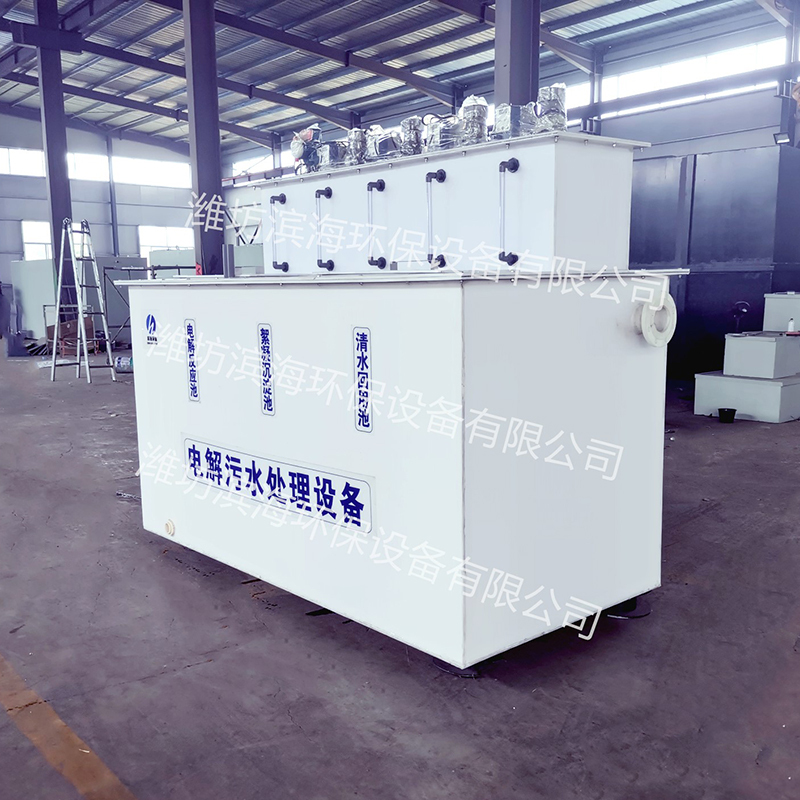
Electrolytic sewage treatment equipment
Electrolytic sewage treatment equipment
Electrolytic sewage treatment equipment
- Detail
- Parameters
Electroflocculation integrated equipment
1. Overview Electrocoagulation wastewater is a complex process, under the action of an external electric field, metal electrodes produce cations into the water body to cause a variety of physical and chemical phenomena.
From ion generation to floc formation, there are three stages
1. Under the action of the electric field, the anode produces electrons to form "microflocculants" - hydroxides of iron or aluminum
2. Particles and colloidal pollutants suspended in the water lose their stability under the action of flocculants
3. The destabilized pollutant particles and the microflocculant collide with each other and combine into a large floc that is conducive to sedimentation
2. The working principle of electrocoagulation equipment
Connect multiple sets of parallel plates to direct current, generate an electric field between the plates, and let the water to be treated flow into the gap of the plate. At this time, the energized plate will undergo an electrochemical reaction, dissolve Al3 or Fe2 plasma and hydrolyze it in water to cause flocculation reaction, in this process, electroflotation, redox and other other actions occur at the same time, as a result of these actions, the dissolved, colloidal and suspended pollutants in the water are effectively converted and removed.
3. Advantages of electrocoagulation wastewater treatment technology compared with traditional processes
1. Electrocoagulation wastewater treatment technology occupies a small area, consumes less energy, and has obvious treatment effects.
2. The equipment is simple, easy to operate, and easy to realize automatic management.
3. Chemical agents need to be added, which can save the cost of chemical agents and dosing equipment.
4. Strong operability, can adjust the voltage and current density according to the change of water quality and quantity, so that the effluent meets the treatment requirements.
4. Successful application of electrocoagulation wastewater treatment technology
Electrocoagulation wastewater treatment technology has been successfully applied to: electroplating wastewater treatment, heavy metal wastewater treatment, electroplating wastewater organic wastewater treatment, food high-concentration wastewater treatment, slaughtering and breeding industry high-concentration organic wastewater treatment, petroleum industry oily wastewater treatment, printing and dyeing non-biochemical high-concentration organic wastewater pretreatment, oily grinding wastewater, cutting liquid wastewater, pesticides, chemical high-concentration refractory wastewater pretreatment.